Showing posts with label puget sound partnership. Show all posts

Friday, July 28, 2023

What is Puget Sound?

My post on Water Quality in Puget Sound explains that,

Puget Sound is the 2nd largest estuary in the United States (Chesapeake Bay is the largest). The Puget Sound drainage basin is 13,700 square miles and includes 13 U.S. counties plus one in Canada. The basin has three physiographic areas including the Olympic Mountains, the Puget Lowlands, and the Cascade Range.
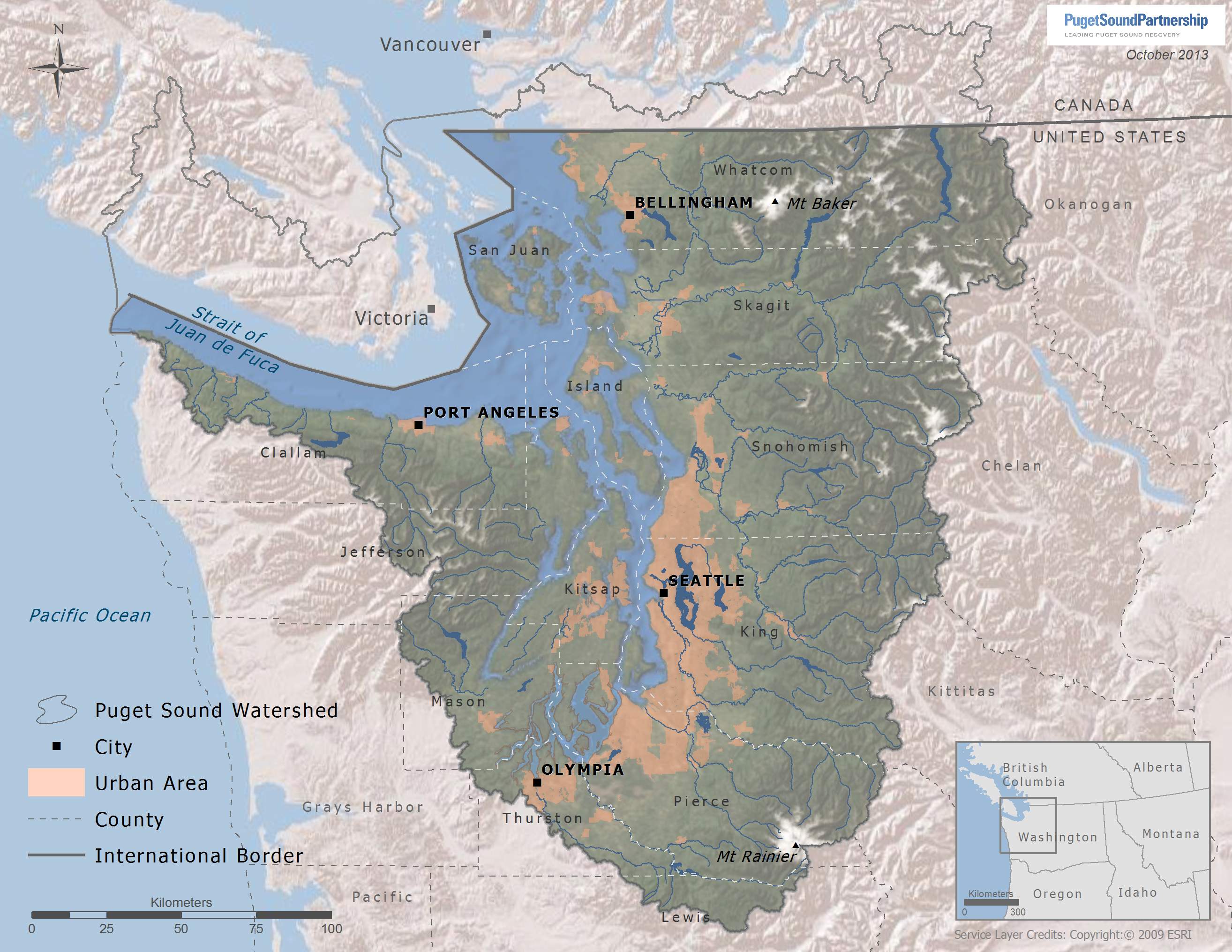
 

Map of Puget Sound watershed boundary, published by the Puget Sound Partnership.

But, why is Puget Sound important and, why should you care about it? One of the biggest reasons is our salmon. We eat salmon, they are a cultural icon and treaty right for several Native American Tribes, and these fish play an important role in the food web which affect the orcas. Even if that isn't something you care about, having beautiful, clean water to swim and play in is another important reason. Stormwater impacts these uses and is the largest input of toxic pollution in Puget Sound. In essence, all of our drains in this region empty in Puget Sound and contribute to this overwhelming problem. See my post on what stormwater is for more details here.

Stormwater is the biggest source of toxic pollution to Puget Sound. Studies by the Washington Department of Ecology show that 75% of the toxic chemicals entering Puget Sound are carried by stormwater runoff flowing off hard, developed surfaces and into our waterways. This pollution impacts our environment, economy, and health. To protect our region’s salmon, orcas, and communities, we must stop stormwater pollution now. 

Hard developed surfaces include the roof of your home, your driveway, and all the roads and parking lots you drive on to get to the grocery store. The University of Washington's Puget Sound Institute maintains the Encyclopedia of Puget Sound. It delves into the issues and concerns impacting the health of Puget Sound. This comprehensive guide shares articles, maps, and reports to help us learn more about Puget Sound's health and explains its importance both regionally and internationally. Their website states, "Our mission: Promote synthesis and improve access to the best available, most relevant scientific information in support of Salish Sea recovery." 

The Puget Sound Partnership is the state-led effort to improve the health of Puget Sound. They receive Federal funding to coordinate and support important efforts in the Puget Sound Partnership Action Agenda. One particularly relevant strategy in the 2022-2026 Action Agenda is Stormwater Runoff and Legacy Contamination. Action items include behavior change and education to reduce nutrient loading (i.e. limit fertilizers and pick up your dog poop! I'm not sure why horse poop isn't treated the same...) and a focus on retrofitting (improving and enlarging) existing stormwater systems which were designed to older standards which are now not protective enough by today's standards.

I hope this gives you a glimpse into what Puget Sound is, why its health matters, and how you can impact it for better or worse.
Sunday, February 6, 2022

Puget Sound Partnership proposing ‘Desired Outcomes’ for Ongoing Ecosystem Recovery

Puget Sound Partnership proposing ‘Desired Outcomes’ for ongoing ecosystem recovery:

Puget Sound Action Agenda, often referred to as Puget Sound Partnership’s blueprint for ecological recovery, continues to evolve. The next Action Agenda — scheduled to go into effect a year from now — will incorporate an expanded long-range vision for Puget Sound, complete with broad-based strategies, not just near-term actions.

“Desired Outcomes,” the first major component of the next Action Agenda, will be unveiled tomorrow (Thursday) before the Ecosystem Coordination Board, the wide-ranging, 27-member committee that advises the Leadership Council in its recovery oversight and strategic planning. A live video of the discussion can been viewed online, as described in the meeting agenda.

“Desired Outcomes are statements that describe what we intend to accomplish — the positive change we want to see in Puget Sound,” states a fact sheet describing the next Action Agenda update. The idea is that near-term actions proposed over four years should fit into a larger vision leading to “transformational change and bold progress toward Puget Sound recovery.”

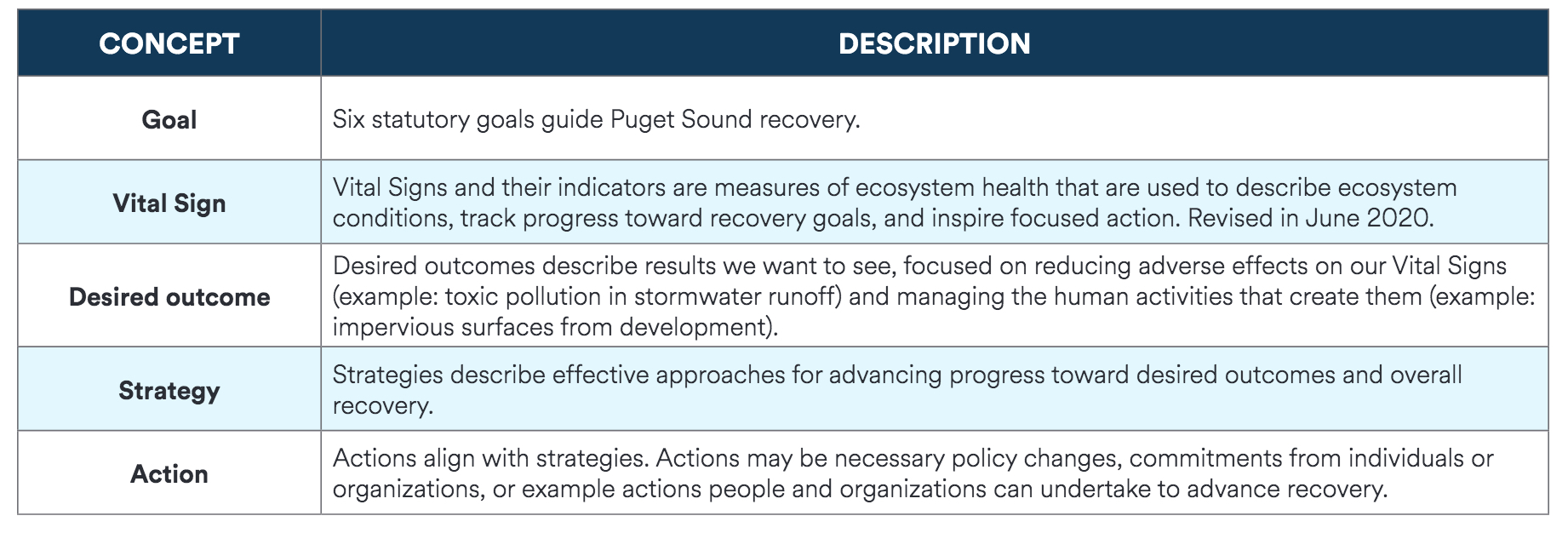
The basic ecosystem-recovery guidance for the Action Agenda has always depended upon the goals spelled out in the 2007 law that established the Puget Sound Partnership:

  • Healthy water quality
  • Protected and restored habitat and abundant water
  • Thriving species and food web
  • Vibrant quality of life, and
  • Healthy human populations

One could say that desired outcomes put meat on those statutory bones. Under habitat, for example, the desired outcome is to protect existing habitat while improving degraded habitat to achieve ongoing ecological gain. On land, that would include increasing the focus on areas defined as “ecologically important,” keeping most development within urban growth areas, and maintaining low-intensity uses on so-called “working lands,” such as farms and forests.

For a more complete description of the desirable changes being discussed, check out the summary paper “Desired Recovery Outcomes.” Climate change, not explicitly mentioned in the 2007 law, has been elevated to a significant consideration.

If planners can agree on these general directions, the next step will be to develop individual strategies to improve the ecosystem in ways that improve the efficiency and reduce the ongoing costs of recovery. The final step is to identify individual actions in line with the strategies.

“We are excited to get the conversations going,” said Dan Stonington, planning manager for Puget Sound Partnership. “We’ve been through a good science-based process, drawing information from a lot of sources. We certainly want input from anybody.”

An online form has been provided to help gather opinions on the desired outcomes project.

Progress toward ecosystem recovery will still be measured with Vital Signs indicators, which were updated and expanded last year. (See also Jeff Rice blog post). Planners are calling this year a “transition year,” in which the old indicators are still being reported while new data are being compiled. The biennial State of the Sound report, scheduled for release in November, will be based largely on the previous indicators, officials say.

While the Desirable Outcomes will point arrows in the direction of progress, the Partnership has not yet begun work on new targets, which will describe how much progress needs to be made by a certain time. We’re still living with targets for the year 2020, which are out of date even if still useful. My blog post of a year ago describes the dilemma (Our Water Ways, Jan. 22).

Meanwhile, Intermediate Progress Measures are under development to track advancement or decline in the march toward Desired Outcomes, ultimately reflecting ecological conditions as measured by Vital Signs indicators. It’s a complex planning process — some say too complex — but it is all about understanding the interconnections that drive the ecosystem and the effects of various human actions.

Besides the concepts of Desired Outcomes driving Strategies and Actions (see below), we are likely to see other changes in the next Action Agenda, at least partly in response to an After-Action Review that reflects a multitude of reactions from folks reviewing the 2018-2022 Action Agenda. One idea is to improve the consideration of ongoing local, state and federal programs that help in overall ecosystem recovery. This will add an extra dimension to the short-term, grant-funded projects that have been a mainstay of past Action Agendas.

Changes to the next action agenda will follow guidance from the Leadership Council, as enunciated in the Beyond 2020 Resolution, the more recent Concept for Developing the 2022-2026 Action Agenda, and the extensive Unabridged 2022-2026 Action Agenda Concept Proposal.

In addition to tomorrow’s meeting of the Ecosystem Coordination Board, the Desired Outcomes proposal will be reviewed by the Puget Sound Salmon Recovery Council on Jan. 28, the Puget Sound Science Panel on Feb. 3, and the Leadership Council on Feb. 18, when the LC is scheduled to adopt the list of outcomes.


The post Puget Sound Partnership proposing ‘Desired Outcomes’ for ongoing ecosystem recovery appeared first on Puget Sound Institute.

Tuesday, February 9, 2021

News Release - Reauthorizing the National Estuary Program (Puget Sound Partnership)

Background Information on Puget Sound Partnership

Below is a news release from Puget Sound Partnership (PSP), the state agency that oversees implementation of the National Estuary Program for Puget Sound. The National Estuary Program (NEP) is an EPA program to protect and restore water quality and ecological function of estuaries of national significance. The NEP is a non-regulatory program established by Congress and was authorized by section 320 of the Clean Water Act in 1987. Puget Sound is one of 28 estuaries in the program. Each NEP develops and implements a long-term plan based on local priorities to guide their efforts. 
PSP was created in 2007 when Washington passed legislation to create the state agency dedicated to protecting and restoring Puget Sound. More about the program can be found at NEP overview (wa.gov). PSP is implementing the 2018 - 2022 Action Agenda. You can view their Action Agenda Tracker for progress. PSP is currently working to develop the 2022 - 2026 Action Agenda, updates can be viewed here. The public comment period for the development of the new Action Agenda is currently scheduled for Feb - June 2022. Other opportunities exist for partners, local governments and tribal organizations to participate in the early phases work. Very exciting stuff!

PSP has a wealth of information on their site, I highly recommend you check it out! And it is good to see excellent efforts like this getting Congressional support.

NEWS RELEASE: Congress moves to invest in the nation's estuaries

Puget Sound Canoe banner

FOR IMMEDIATE RELEASE
February 1, 2021


MEDIA CONTACT: Kevin Hyde, 360.819.3045, kevin.hyde@psp.wa.gov