Friday, July 28, 2023

What is Puget Sound?

My post on Water Quality in Puget Sound explains that,

Puget Sound is the 2nd largest estuary in the United States (Chesapeake Bay is the largest). The Puget Sound drainage basin is 13,700 square miles and includes 13 U.S. counties plus one in Canada. The basin has three physiographic areas including the Olympic Mountains, the Puget Lowlands, and the Cascade Range.
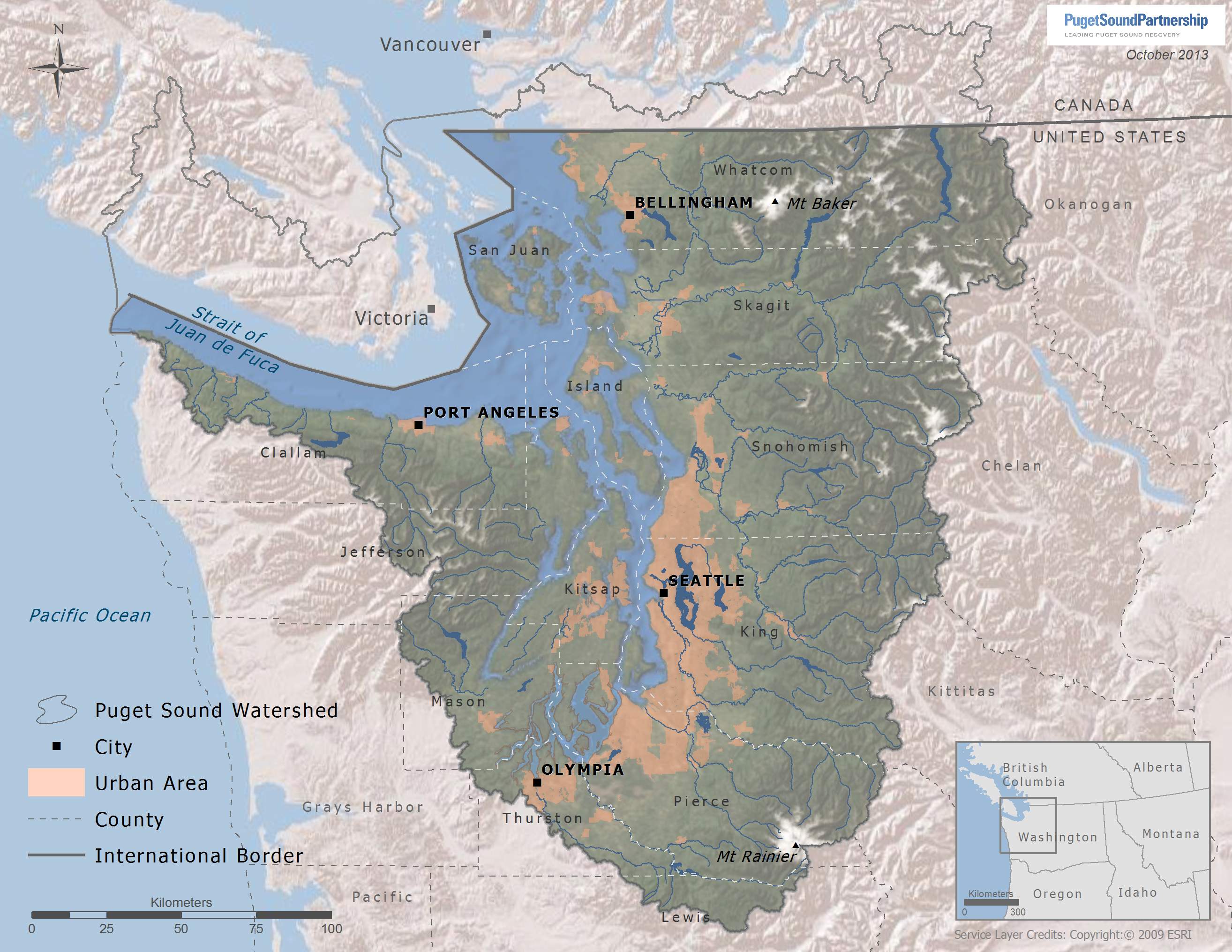
 

Map of Puget Sound watershed boundary, published by the Puget Sound Partnership.

But, why is Puget Sound important and, why should you care about it? One of the biggest reasons is our salmon. We eat salmon, they are a cultural icon and treaty right for several Native American Tribes, and these fish play an important role in the food web which affect the orcas. Even if that isn't something you care about, having beautiful, clean water to swim and play in is another important reason. Stormwater impacts these uses and is the largest input of toxic pollution in Puget Sound. In essence, all of our drains in this region empty in Puget Sound and contribute to this overwhelming problem. See my post on what stormwater is for more details here.

Stormwater is the biggest source of toxic pollution to Puget Sound. Studies by the Washington Department of Ecology show that 75% of the toxic chemicals entering Puget Sound are carried by stormwater runoff flowing off hard, developed surfaces and into our waterways. This pollution impacts our environment, economy, and health. To protect our region’s salmon, orcas, and communities, we must stop stormwater pollution now. 

Hard developed surfaces include the roof of your home, your driveway, and all the roads and parking lots you drive on to get to the grocery store. The University of Washington's Puget Sound Institute maintains the Encyclopedia of Puget Sound. It delves into the issues and concerns impacting the health of Puget Sound. This comprehensive guide shares articles, maps, and reports to help us learn more about Puget Sound's health and explains its importance both regionally and internationally. Their website states, "Our mission: Promote synthesis and improve access to the best available, most relevant scientific information in support of Salish Sea recovery." 

The Puget Sound Partnership is the state-led effort to improve the health of Puget Sound. They receive Federal funding to coordinate and support important efforts in the Puget Sound Partnership Action Agenda. One particularly relevant strategy in the 2022-2026 Action Agenda is Stormwater Runoff and Legacy Contamination. Action items include behavior change and education to reduce nutrient loading (i.e. limit fertilizers and pick up your dog poop! I'm not sure why horse poop isn't treated the same...) and a focus on retrofitting (improving and enlarging) existing stormwater systems which were designed to older standards which are now not protective enough by today's standards.

I hope this gives you a glimpse into what Puget Sound is, why its health matters, and how you can impact it for better or worse.

Sunday, July 10, 2022

New NPDES Permit Coming in 2024

About one year from this month, the Department of Ecology's (DOE) National Pollutant Discharge Elimination System (NPDES) Municipal Stormwater Permit will expire on July 31st, 2024. This will happen as part of the regular 5-year permit cycle. The DOE and permit holders are already hard at work on what the 2024-2029 Permit will look like. 

The changes to the permit make a significant impact on the local requirements for stormwater regulations in Washington State. Significant updates to be proposed to the permit will include:

  • Address tire wear research findings – Road Runoff
  • Update Stormwater Planning & Structural Stormwater Control programs
    • Consider retrofit implementation program for Phase II
  • Enhance Source Control requirements 
    • Street sweeping program
    • PCBs in building materials

NPDES Permit Timeline


  • Fall 2022/Early 2023 - Preliminary drafts of permit sections may be provided for specific permit sections for informal comment.
  • Late Summer/Fall 2023 - Draft Permits will be issued. DOE will hold a formal public comment period, which will include a workshop and hearing, on the draft permits.
  • July 2024 - DOE will make the decision to reissue the NPDES Permits.

Listening sessions were held by the DOE on June 6 and 13, 2022. The presentation can be viewed here. An excellent video of the upcoming changes to the stormwater manual was played during the listening session. I summarized those changes below. You can watch the video on YouTube here.

Early Input

In preparation for the new permit language, several municipal permittees participated in ad-hoc groups hosted by the Washington Stormwater Center and led by local government staff to develop white papers on a variety of topics. The white papers provided early input to the DOE on the next permit cycle and give insight to the opinions of local jurisdictions on how to improve the permit requirements to continue to protect our local creeks. 

The white papers focused on the following areas:

Additional information on the ad-hoc process can be found at https://www.wastormwatercenter.org/permit-assistance/municipal/2024-western-washington-ad-hoc-process/.


Stormwater Manual Updates

The Eastern Washington and Western Washington Stormwater Management Manuals were previously published on different timelines, which created issues in the process. This permit cycle, DOE will publish both manuals on the same schedule.


Planned Changes to Stormwater Manuals

  1. Statewide Consistency
  2. General Usability and Clarifications
  3. New (to the Manual) Pollutants - pollutant specific guidance will be added to the SWMMWW Volume I-1.4 for Nitrogen, PCBs, and 6PPD-quinone
  4. Climate Change - this will be a new topic added to the manuals. For Western Washington rainfall data from 1948-2009 is used for continuous simulation modeling to design stormwater facilities. DOE explained that they do not think adding the latest 12 years of data would make a significant difference, which I tend to agree with. Instead, they will spend time researching and recommending an alternate way to size stormwater facilities using future predicted rainfall data.This is not likely to be implemented for this manual update.
  5. Wetlands - they will refine wetland guidance to make the Minimum Requirements 7 and 8 more realistic to achieve while still protecting wetlands.
  6. Street Sweeping -
  7. Bioretention Soil Mix - will have several soil mix options added to allow use around phosphorus sensitive lakes. Past soil mixes were found to be a source of phosphorus.