Sunday, April 11, 2021

New Study Shows Artifical Turf Generates More Runoff Than Grass

A new study published in the journal, Science of the Total Environment, concludes that artificial turf lawns and xeriscaping generate more runoff than traditional turf lawns. The objective of the two-year study, conducted at Texas A&M over the two-year period from August 2018 to August 2020, was to "evaluate the total rainfall capture and runoff volumes generated...from several commonly used residential landscape types and to characterize the flow dynamics and peak flow of surface runoff in relation to rainfall intensity for each landscape."


Notably, the study was funded in part by Scott's Miracle-Gro Company, which obviously has an interest in keeping traditional turf, but the conclusions seem reasonable. The study ultimately states that, 

Beginning spring 2019, after plots were established and settled in, and through the end of the study, Sand-Capped Lawn and Mulch generally had significantly lower runoff volumes than all other landscapes. The native soil-based St. Augustinegrass Lawn maintained moderately low runoff volumes, while Xeriscaping and Artificial Turf each showed the highest runoff volumes.

The study caveats this finding by explaining that the sand-capped lawn and mulch both exhibited larger runoff volumes during establishment due to getting the sod to grow in the sand layer and the fines being washed out of the mulch. Their goal was to understand how more water efficient landscapes, which are becoming increasingly popular through water conservation efforts and rebate programs, would impact runoff characteristics. 

From professional experience, I know that artificial turf is becoming increasingly common around the Puget Sound region. To my knowledge, there is little regulation surrounding installation of artificial turf. In addition, little is known about the potential impacts of replacing lawn with artificial turf may have on our stormwater systems, local creeks, and water quality. 

Most of the information I found initially, when researching artificial turf, is from studies on the possibility for causing cancer from tire crumb rubber in sports fields. The EPA's final report was partially rolled out, but the data on potential human exposures was delayed because of COVID-19. 


Even without the EPA's final report, artificial turf materials have evolved and are more widely accepted for sports use. During the 2015 drought in California, a bill was signed into law revising California's Civil Code Section 4735 and now prohibits HOAs from restricting the use of artificial turf. 

Similar to the efforts on understanding human health concerns, we now must work to understand the environmental impacts of artificial turf when it replaces grass lawns, especially in residential areas. I would not install artificial turf in my yard, and I hope you think twice about installing it yourself. While it has become widely accepted on sports fields across the U.S., I do not think it is wise to install it in our yards. With urbanization, we cannot completely avoid increases runoff but it is important to understand that replacing our yards with artificial turf could further increase runoff and create additional flooding problems in the future. 


Citation

B. Chang, B. Wherley, J.A. Aitkenhead-Peterson, et al., Effects of urban residential landscape composition on surface runoff generation, Science of the Total Environment (2021), https://doi.org/10.1016/j.scitotenv.2021.146977.

Sunday, March 28, 2021

Stormwater Tunnel to Reduce CSOs in Seattle

KIRO 7's article on March 12th was the first news mention I saw of this project from Seattle and King County. Yesterday, MyNorthwest picked up the story too, as the project draws closer to constructing the tunnel, however, this kind of project takes many years to get going on the ground. Design began in 2019 according to the schedule on the project website, but project planning started at least as early as 2017 when Seattle Public Utilities began onboarding the consultants to help manage and oversee the $570M project, according to the Seattle Daily Journal of Commerce article from August 2017.

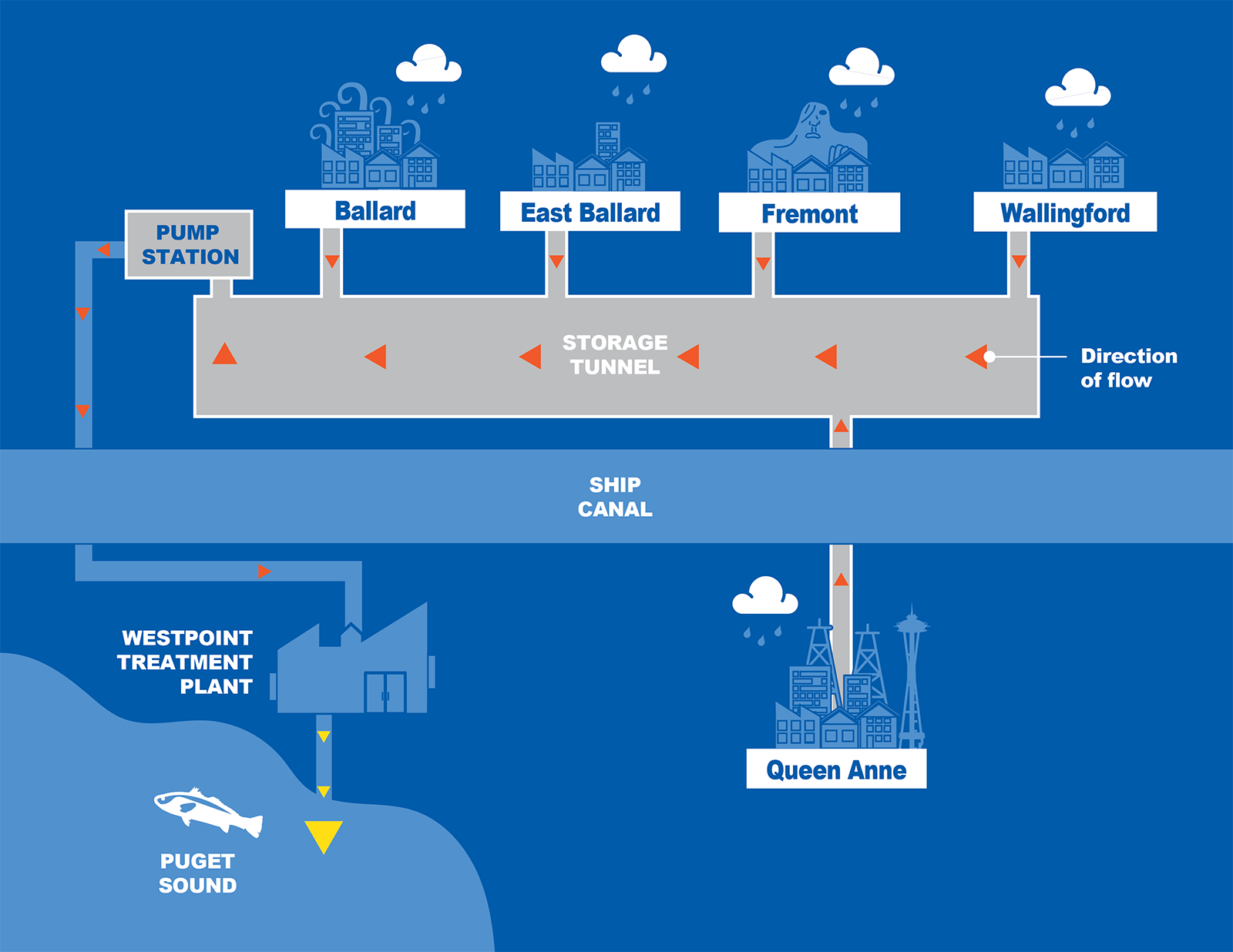
Diagram explains how the new Ship Canal Storage Tunnel works

How the new Ship Canal Storage Tunnel works.

The Seattle Daily Journal of Commerce noted that the new stormwater tunnel would be constructed in order for Seattle and King County to comply with a Federal mandate to reduce the number of CSO events to an average of one over the span of 20 years. At that time, they averaged 130 CSO events per year. The County expects to complete 14 CSO control projects by 2030 to complete its Protecting Our Waters program, King County's effort to reduce CSOs and comply with the consent decree.

According to the King County website on CSOs:
In 2013 King County signed an agreement with the U.S. Department of Justice and the Environmental Protection Agency (EPA). This agreement, called a “consent decree,” requires King County to complete its CSO control plan by 2030. Download and read the consent decree agreement. 

The Ship Canal Water Quality Project will bore a 2.7 mile long tunnel from Ballard to Wallingford. Its' purpose is to store combined sewer overflows (a mixture of mostly stormwater with some wastewater), which currently outfall to Lake Union, Salmon Bay, and Ship Canal (ultimately flowing to Puget Sound) during large storms via the West Point Treatment Plant. This new tunnel will prevent the discharge of up to 75 million gallons of  CSO overflows on average per year.

According to the Seattle Public Utilities web page on the project:

In 2018, 84% of the city's overflows came from the combined sewers in Crown Hill, Ballard, Fremont, Wallingford, Queen Anne, Downtown and Capitol Hill. During a heavy storm, the new tunnel will capture and temporarily store more than 29 million gallons of untreated stormwater and sewage until the treatment plant is ready for it.

Construction began in 2020 with the tunnel boring planned to begin in late spring this year. According to the consent decree, the project must be operational by 2025. The tunnel boring machine (TBM) was imported from Germany and arrived at the Port of Tacoma in January 2021. The TBM weighs 450 tons, travels 58 feet per day, and is currently being assembled in Ballard. Neighborhoods impacted by construction include Ballard, Fremont, Queen Anne, and Wallingford. Each neighborhood has a section on the project website explaining the current construction stage and impacts to the area such as road closures and detours. The map below shows the tunnel alignment and various project sites to house additional infrastructure to support its operation.

Image map of project.

Seattle Public Utilities and King County are building an underground stormwater and sewer storage tunnel.

Vote for your favorite Tunnel Boring Machine (TBM) name!

From March 24th to March 31st, while you are waiting to be eligible for the COVID vaccine, you can vote for your favorite tunnel boring machine name! Below are the five names that made it to the voting slip. My personal favorite is Daphne!

  • Daphne
  • Molly the Mole
  • Boris the Plunger
  • Sir Digs-A-Lot
  • MudHoney
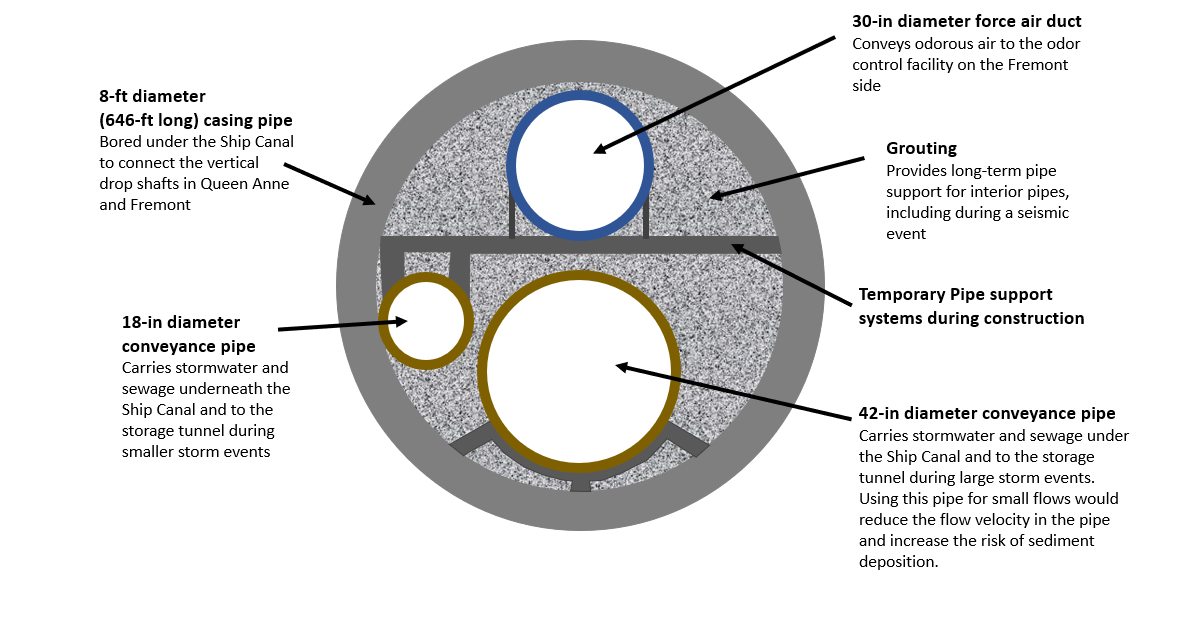
The 2.7 mile long tunnel and 8-ft diameter casing will house a number of features to convey and store the diluted wastewater, including a 30-in air duct to control odors, an 18-in diameter conveyance pipe for conveying smaller storms, a 42-in diameter conveyance/storage pipe for larger storms, and associated support for those systems.
A graphic rendering looking inside an eight-foot diameter storage tunnel. Three smaller white circles with colored borders inside the larger gray tunnel indicate different elements of the tunnel. Gray lines inside the tunnel represent temporary pipes.
For more information, check out the Ship Canal Water Quality Project's Project Library for update emails, photos, videos, and other resources!

Sunday, March 7, 2021

ASCE 2021 Report Card for America’s Infrastructure Gives Stormwater a "D"

Nationwide Stormwater Infrastructure Gets a "D"

ASCE's Infrastructure report card is released every four years. This year, stormwater is a new category and was given a D grade. According to the Executive Summary of the Stormwater Report,
"With few dedicated funding sources, complicated governance and ownership structures, expansive networks of aging assets, increasingly stringent water quality regulations, and concerning climate change projections, the expected performance of stormwater systems is declining. Many of the country’s legacy stormwater systems are struggling with the high cost of retrofits needed to address urban flooding and climate change. Upgrading large networks of aging systems underneath densely populated areas carries significant costs and engineering challenges."


A few of the notable recommendations to improve the D grade given in the report include making stormwater design mainstream in the development planning process, to include climate variability in stormwater codes, and to educate the public on the true costs, savings, risks, and avoided hazards associated with stormwater infrastructure investments:
  • Stormwater infrastructure and design regulations are critical for protecting communities from costly urban flooding and protecting water quality in our waterways. Stormwater systems should be a combination of gray, green, and natural infrastructure and should be mainstreamed in planning and development processes nationwide. 
  • Expand the inclusion of current and forecasted climate variability in codes and standards for the design, operation, maintenance, and expansion of stormwater infrastructure and routinely provide funding to NOAA to update the climate data. 
  • Develop a comprehensive education campaign on the true costs, savings, risks, and avoided hazards associated with stormwater infrastructure investments, and disseminate these details through broadly accessible platforms. 

ASCE's 2021 Report Card Released March 3rd, 2021

ASCE’s 2021 Report Card for America’s Infrastructure, released March 3, assessed U.S. infrastructure with an overall C- grade.

And while that marks an improvement over the D+ grade on ASCE’s 2017 Report Card and is the highest overall grade in 20 years for the nation’s infrastructure, the report found that the long-term infrastructure investment gap continues to grow. That gap has risen from $2.2 trillion over 10 years in the last report to $2.59 trillion in the latest study, meaning a funding gap of nearly $260 billion per year.

“We have not made the investments to maintain infrastructure that in some cases was built more than 50 years ago,” said ASCE Executive Director Tom Smith.

“As this study shows, we risk significant economic losses, higher costs to consumers, businesses and manufacturers – and our quality of life – if we don’t act urgently. When we fail to invest in infrastructure, we pay the price.”


Using an A to F school report card format, ASCE’s Report Card for America’s Infrastructure provides a comprehensive assessment of current infrastructure conditions and needs, evaluating 17 categories.

The individual 2021 grades ranged from a B for rail to a D- for transit. Despite incremental gains, 11 of the 17 categories received a grade in the D range. Five category grades – for aviation, drinking water, energy, inland waterways, and ports – went up from the last report in 2017, while one category – bridges – went down.

“I believe the overall grade of a C- shows that we’re on the right track but have a ways to go,” said Ruwanka Purasinghe, EIT, A.M.ASCE, member of ASCE’s Committee on America’s Infrastructure. “We’ve seen over the past four years that with proper resources, implementation, and funding, we can really make a meaningful impact on our infrastructure. I’m also excited to see how innovation and technology will continue to change the way we approach and provide solutions for our aging infrastructure.”

The 2021 Report Card found three overarching trends affecting infrastructure:

• Maintenance backlogs continue to be an issue, but asset management helps prioritize limited funding.

• Federal investments can significantly move the needle, as seen in the improved inland waterways, ports, and drinking water grades. Additionally, state and local governments have made progress, such as leveraging gas tax to fund transportation investments.

• There are still infrastructure sectors where data is scarce or unreliable.

ASCE revealed the grades through a virtual news conference, followed by the ASCE Solutions Summit. Maryland Gov. Larry Hogan (R) spoke during the Report Card release: “This is something that both Republicans and Democrats say should be a top priority. If we can’t come to a consensus on infrastructure across the aisle, I’m not sure we can find bipartisan consensus on anything. … I think it’s critically important for us that we invest in our infrastructure so we can be an example to the rest of the world.”

The ASCE Committee on America’s Infrastructure, made up of 31 civil engineers from across the country with decades of expertise in all categories, prepared the Report Card, assessing all relevant data and reports, consulting with technical and industry experts, and assigning grades using the following criteria: capacity, condition, funding, future need, operation and maintenance, public safety, resilience, and innovation. In support of ASCE’s experts, a research team of EBP, Downstream Strategies, Daymark Energy Advisors, and the Interindustry Forecasting Project at the University of Maryland (INFORUM) helped develop the study. 

Read more about the Report Card, including deep dives into each infrastructure category, in Civil Engineering magazine.

To view the full report, visit InfrastructureReportCard.org.

The post 2021 Report Card for America’s Infrastructure grades reveal widening investment gap appeared first on Civil Engineering Source.

Sunday, February 28, 2021

Breaking News! Executive Constantine Declares Emergency for West Point Treatment Plant

King County Executive Dow Constantine Declares Emergency for West Point Treatment Plant Improvements

King County Executive Dow Constantine on February 25th issued an emergency declaration requesting up to $65 million to fund power improvements to the West Point Treatment Plant.

In the past 20 years, the West Point Treatment Plant diverted a highly diluted mixture of stormwater and wastewater into Puget Sound 15 times because Seattle City Light power disruptions caused equipment shutdowns when the plant was operating at or near capacity. More than half of these bypasses – 53 percent – occurred over the past five years.

The work under the emergency declaration will include immediately purchasing services and equipment to provide more reliable power, an evaluation of whether direct high-voltage power will resolve the power outage problems, and modifying on-site power generation and an option to use batteries as other possible solutions.

According to the transmittal letter with the legislation, the reason for the emergency declaration and supplemental funding is in response to the WA Department of Ecology's Administrative Order issued on February 2nd. 

On February 2, 2021, the Washington State Department of Ecology (Ecology) issued Administrative Order 19477 to King County regarding unauthorized bypasses of the secondary treatment system at WPTP between January 1, 2018 and June 30, 2020 [...]. The DOE Order requires DNRP to complete four corrective actions, which include the submittal of two reports to Ecology, development of a strategic master plan for WPTP’s electrical system by December 31, 2021, and implementation of the corrective actions in the plan by December 31, 2025.

The emergency declaration will be discussed by the King County Council at a future meeting. 

King County Councilmember Reagan Dunn issued a statement on February 24th after the Mobility and Environment Committee approved his legislation to require an extensive report and recommendations to prevent future wastewater spills like those on January 13. 

At a $65 million price tag, it will be interesting to see how this reflects on property tax bills in the future. If you live in the service area, I highly suggest you keep posted on future updates and opportunities for public input to see how they choose to resolve these issues and how they will fund the solutions going forward.

When Stormwater Becomes Wastewater

Wastewater, commonly known as sewage, is an entirely different type of flow from stormwater. These flows intersect drastically in Washington's wet winter months, especially in Seattle where stormwater and wastewater were collected together in a combined system which can cause combined system overflows (CSOs). After the 1940s, we learned the importance of constructing separate pipe systems to convey these flows to specifically treat them before release. In fact, stormwater treatment has become its' own science. The legacy systems that remain, primarily in older cities, can create excess flows that overwhelm our wastewater treatment facilities or directly discharge diluted sewage into Puget Sound.

King County runs the regional sewer system that was passed by the public in 1958 which created the wastewater treatment division, which was at that time known as Metro. Building the system took off and was running by the late 1960s. While wastewater treatment and water quality have improved much since then, we still see problems when stormwater inflows to the wastewater system and generates too much inflow. Recent sewer overflows have occurred due to power outages, but the overarching issue from a stormwater perspective is how to reduce the amount of stormwater being sent to our wastewater treatment systems. A map of Seattle's/King County's combined sewer overflow points and their current status can be viewed here. Learn more about CSOs in Seattle here.

King County - Sewage Overflows Increase in Last 5 Years

On February 25th, an unquantified amount of sewage overflowed into Lake Washington due to a power outage at the Kirkland Pump Station. The Kirkland Marina Beach Park was closed and has since reopened after water quality testing confirmed that the water is safe. Sewage overflows and water quality goes hand-in-hand and King County is no stranger to this problem.

Last month, an article from the Kitsap Sun reported on the large overflow released into Puget Sound by the West Point Treatment Plant, 80% of which was comprised of stormwater in January. The overflows were announced by King County's newsroom. The overflows into Puget Sound occurred due to power outages during the early morning on Wednesday, January 13th. All systems were back online within 2 hours, but all told 11 million gallons of untreated wastewater flowed into the Sound. Coincidentally, 11 million gallons was the amount of crude oil that was spilled from the Exxon Valdez in Prince William Sound in 1989, which was the largest oil spill in the U.S. before it was surpassed by the Deepwater Horizon disaster in 2010.

According to King County, the West Point Treatment Plant treats up to 90 million gallons per day (mgd) during the dry season and up to 300 mgd during the rainy season (for flows exceeding 300 mgd, they treat up to 440 mgd with primary treatment, i.e. solids removal of about 50% of the organic solid waste, and disinfection only). During winter months 53% of flows into West Point are stormwater inflow and groundwater infiltration, while 29% is residential, 17% from businesses, and 1% from industrial processes.

The Kitsap Sun described the concerns of the Suquamish Tribe on the WPTP sewer overflows which is impacting their ability to harvest shellfish. The tribe filed a notice of intent to sue King County in Summer 2020 over the continued sewage overflows. They want to see increased commitment by King County to keep our waters clean in accordance with the Clean Water Act. From the Kitsap Sun:

Said Suquamish Tribal Chairman Leonard Forsman at the time in a statement: "We acknowledge that King County has invested and will invest more to improve their wastewater treatment system, but the Suquamish Tribe and its members are frustrated by the ongoing sewage releases and King County’s other pollution violations in Puget Sound, which continue to harm marine water quality and the tribe’s ability to exercise reserved treaty rights and engage in cultural activities. We are running out of time and need swifter action."

It is important to recognize the effort and improvement we have made to treat wastewater and separate stormwater flows since the 1950s. But, more can be done.  

What We Can Do

We can participate in this legislation and focus on reducing stormwater inputs to the system. This includes supporting green infrastructure projects in City infrastructure and on residential lots. The City of Seattle has rebates for installing green stormwater infrastructure like rain barrels, cisterns, or rain gardens. As I have mentioned in other posts, planting trees is always helpful and is a fun way to introduce your kids to stormwater. With Earth Day coming up, it is a great time to start planning these activities now.

See my Resources Page for more information on Green Stormwater Infrastructure.

References

History of our mission - King County

2021 news releases - King County

11 million gallons of stormwater, sewage flow into Puget Sound from King County plant: - Kitsap Sun

West Point Treatment Plant Process Diagram

Suquamish Tribe files notice of intent to sue King County for ongoing sewage spills – The Suquamish Tribe 

Executive Constantine requests $65 million and signs emergency declaration to protect West Point Treatment Plant from power disruptions - King County

King County - File #: 2021-0116 - West Point Emergency Declaration and 2021-0116 Transmittal Letter.pdf

Wednesday, February 24, 2021

February 26th Toxics Workshop- Setting the Stage

On Friday, February 26th the Puget Sound Partnership will host their second Toxics Workshop focused on identifying red flags and influencing change for improving the health of Puget Sound. The workshop will run from 9 AM - 1 PM, with a Red Flag overview and breakout session starting around 12:15 PM. Red flags previously identified include contamination in the Duwamish, microplastics, PBDEs in juvenile Chinook, marine and freshwater contaminants, PFAS in rivers and lakes, and contaminants of emerging concern, such as tires and air quality impacts from wildfires and transportation.

The keynote speaker is attorney Rob Bilott of Taft Law, who is scheduled to speak at 9:05 AM. Bilott is portrayed by Mark Ruffalo in the film Dark Waters which tells the story of his fight against the DuPont chemical company in West Virginia. Bilott won a $671 million settlement on behalf of over 3,500 plaintiffs over the pollution of the small town's drinking water with PFOA (a manmade chemical which is used in products like stain-resistant carpet, water-repellent clothes, and firefighting foam - it is a type of PFAS) which DuPont allegedly knew was contaminating the water. You can read more about the film and watch the trailer at Dark Waters and the True Story of Lawyer Rob Bilott | Time.

Other speakers include:
  • Heidi Siegelbaum, Washington State University/Washington Stormwater Center
  • Derek Day, Washington State Department of Ecology
  • Robin Gregory, Decision Science and the University of British Columbia
  • Laurie Valeriano, Toxic Free Future
  • Paulina Lopez, Duwamish Clean Up Coalition
  • Sophorn Sim, Refugee Federation Service Center
  • Marie Splaine, Washington State Department of Commerce
This workshop is designed for those involved in areas such as policy, regulatory, consumer campaign, product redesign, pollution prevention, and communications. The workshop will not cover the underlying science, but appears to be focused on influencing behavioral change through problem solving and collaboration tools to positively impact Puget Sound. Part of the discussion will also focus on setting priorities for future workshops.

If you are interested in attending, you can register at: 


Original Post:
February 26th Toxics Workshop- Setting the Stage:

Please join the Stormwater Initiative Lead Team and its speakers and collaborators on February 26th to kick-off our first solutions-oriented workshop to address Toxics in Puget Sound. This will be the first of successive workshops designed to address toxics in Puget Sound. Our first workshop—February 5th—highlighted a series of toxics challenges, that we called ‘red […]

The post February 26th Toxics Workshop- Setting the Stage first appeared on Strategic Initiatives of the Puget Sound National Estuary Program.